

BLOG
Common Challenges in Knitting Modacrylic Blended Yarns
[ 20.10.2026]
 Common Challenges in Knitting Modacrylic Blended Yarns
Modacrylic blended yarns are widely used in flame-retardant (FR) protective clothing. However, knitting these yarns requires careful control of yarn properties, machine settings, and fabric construction to achieve consistent quality.
1. Yarn Breakage and Knitting Stability
Modacrylic blends may behave differently depending on fiber composition, yarn structure, and yarn quality. Inconsistent yarn tension or unsuitable machine settings can lead to yarn breakage and production interruptions.
Solution: Select suitable yarn specifications and optimize machine speed, yarn tension, and feeding settings.
2. Fabric Surface Irregularities
Differences in fiber characteristics and yarn structure can affect fabric appearance. Uneven yarn feeding or inconsistent raw materials may cause visible variations in the knitted fabric.
Solution: Maintain consistent yarn quality and monitor knitting conditions throughout production.
3. Fabric Weight and Dimensional Stability
Achieving the required fabric weight, stretch, and dimensional stability can be challenging when developing different Modacrylic blends.
Solution: Carefully control stitch length, knitting structure, and finishing conditions. Test fabric weight, shrinkage, and dimensional stability before bulk production.
4. Balancing Comfort and Protection
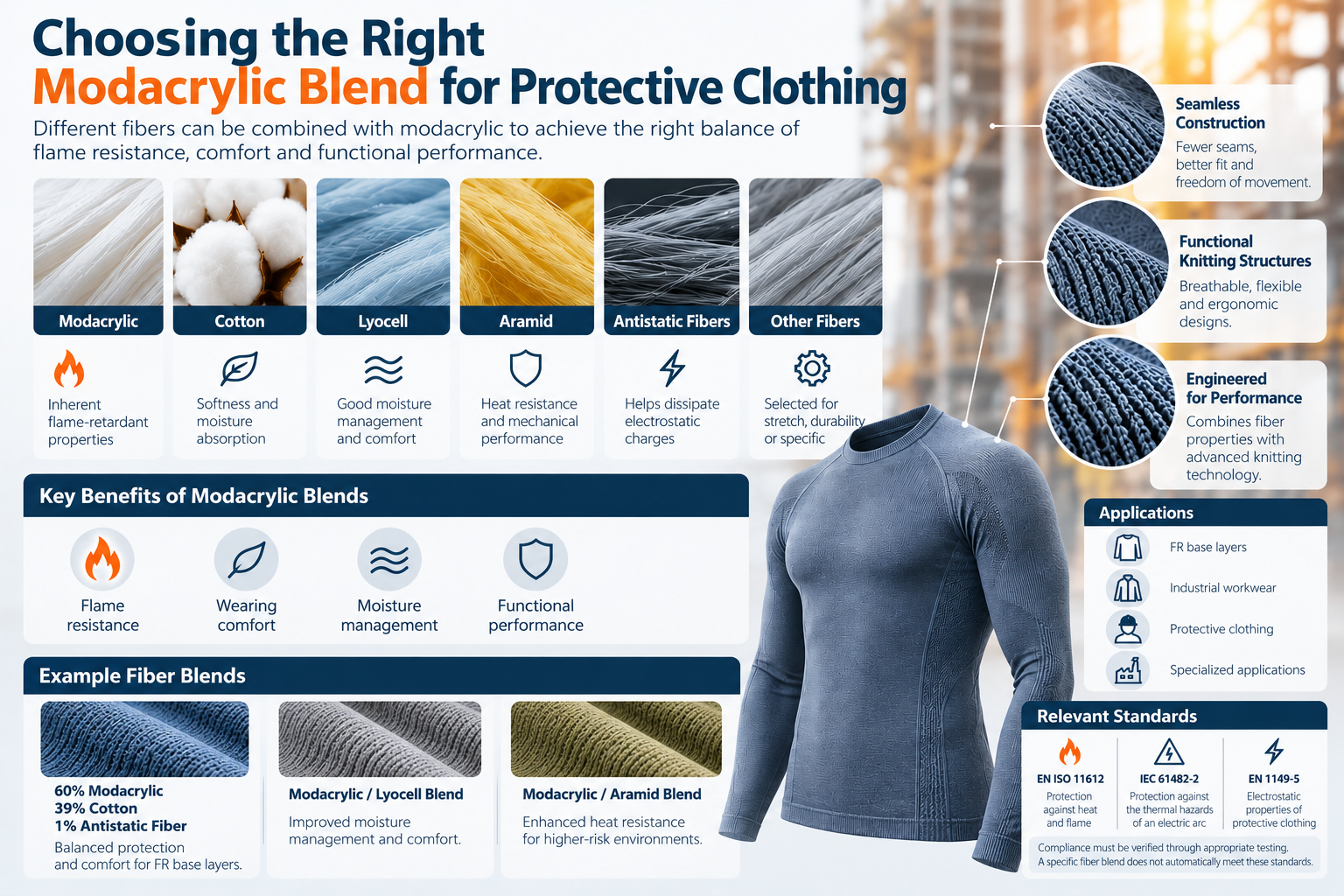
Modacrylic blends can incorporate different fibers, including cotton, Lyocell, aramid, and antistatic fibers. Each combination affects fabric properties differently.
The challenge is to balance wearer comfort, moisture management, flexibility, and the protective performance required for the intended application.
Solution: Select the fiber blend and fabric construction according to the garment’s end use and applicable performance requirements.
5. Maintaining Consistent Fabric Quality
Variations in raw materials, machine settings, and finishing processes can affect the consistency of the finished fabric.
Solution: Establish quality checks for incoming yarn, knitting production, fabric weight, appearance, and finished-fabric performance.
6. Verifying Flame-Retardant Performance
A suitable knitting process helps produce consistent fabric, but knitting alone does not guarantee flame-retardant performance. Fiber composition, fabric construction, finishing, and garment design can all influence the final result.
Depending on the intended application, relevant requirements may include EN ISO 11612, IEC 61482-2, and EN 1149-5.
Manufacturers and buyers should verify compliance through appropriate testing of the finished fabric or garment.
Conclusion
Knitting Modacrylic blended yarns requires careful coordination between yarn selection, machine settings, fabric construction, and quality control.
At Keensun, we develop technical knitted fabrics and seamless FR base layers using different fiber combinations to meet specific protective clothing requirements.
Looking for a reliable manufacturing partner for your next FR knitwear project?
Visit www.keensunsafety.com or contact info@keensunsafety.com to discuss your requirements.
[Back]